Exploring Middle Franconia · Company Feature · Part 3: Production
When Straight Is Not Enough: Custom Work in the Stahldeko Workshop
A seven-sided bay window, a curtain track around a fireplace projection, or a curved rail for a draft barrier: Some spaces call for shapes that standard products cannot provide. In Emskirchen, Stahldeko makes these solutions to measure. A look inside the workshop shows why drawings, templates, and careful inspections matter.
01 / Workshop and fabrication
A Workshop for Shapes You Won’t Find in a Catalog
Long metal profiles lie on the workshop floor. Some are straight; others turn at precise angles or form broad, sweeping curves. Measuring tools, drawings, and templates are nearby. What initially looks like an assortment of unusual metal shapes has a practical purpose: Each piece is intended to fit a specific space.
In Emskirchen, Stahldeko manufactures curtain rods, curtain tracks, shower curtain rods, and other metal components for residential and commercial use. Alongside straight designs, the workshop produces many custom shapes. A bay window may have five or seven sides, a curtain track may need to pass around a fireplace projection, or a thermal curtain may need to shield an entrance. Fixed standard lengths alone cannot solve these tasks.
The work therefore often begins long before the finished component: with determining the path the rod or track must follow and how it can be mounted and operated.
02 / Room geometry
It Starts with the Geometry of the Space
For a straight curtain rod, length and mounting method are usually the main starting points. A multi-sided bay window is more demanding: The individual lengths and angles must fit together. Even small deviations can prevent the finished assembly from following the window line accurately.
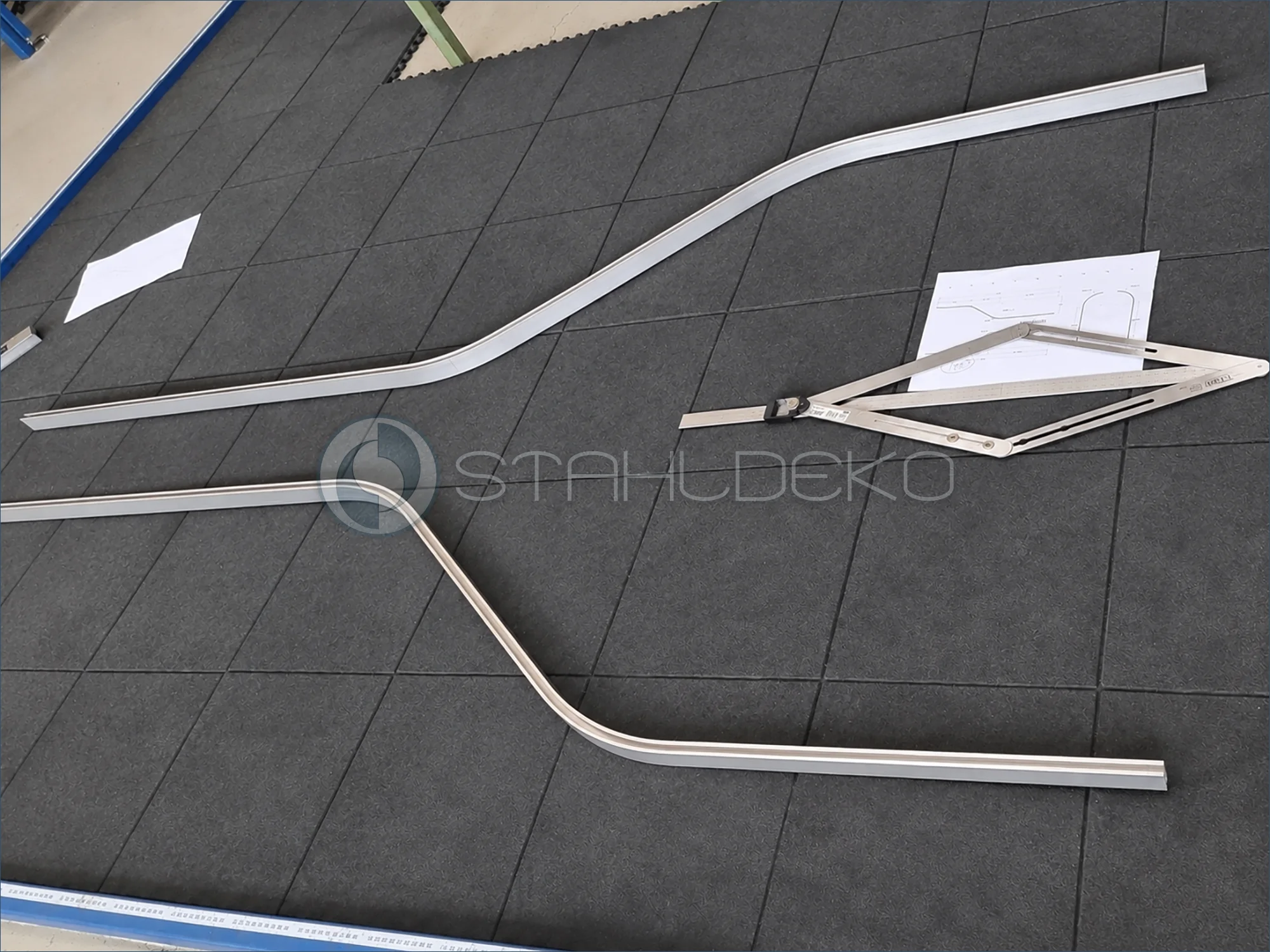
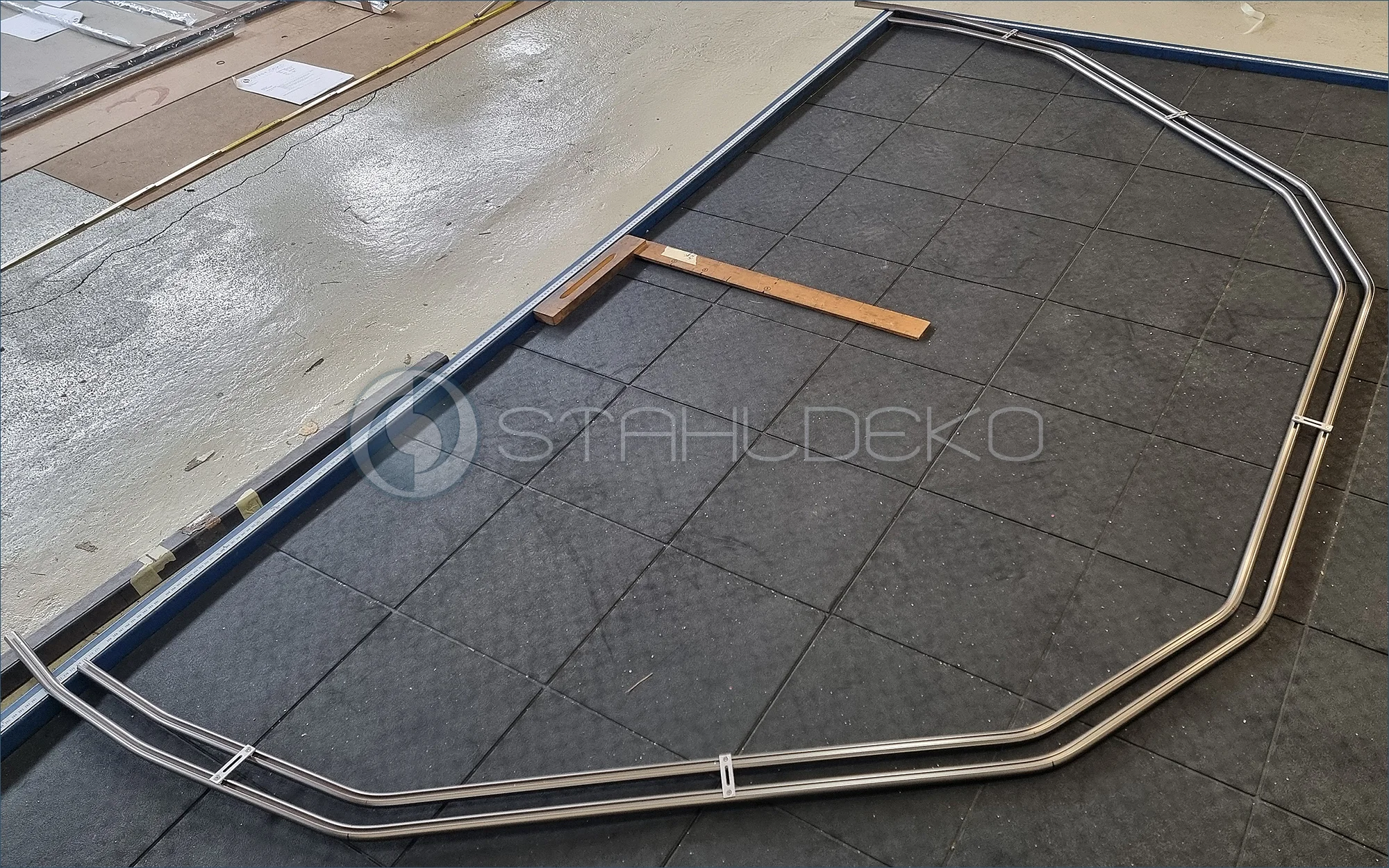
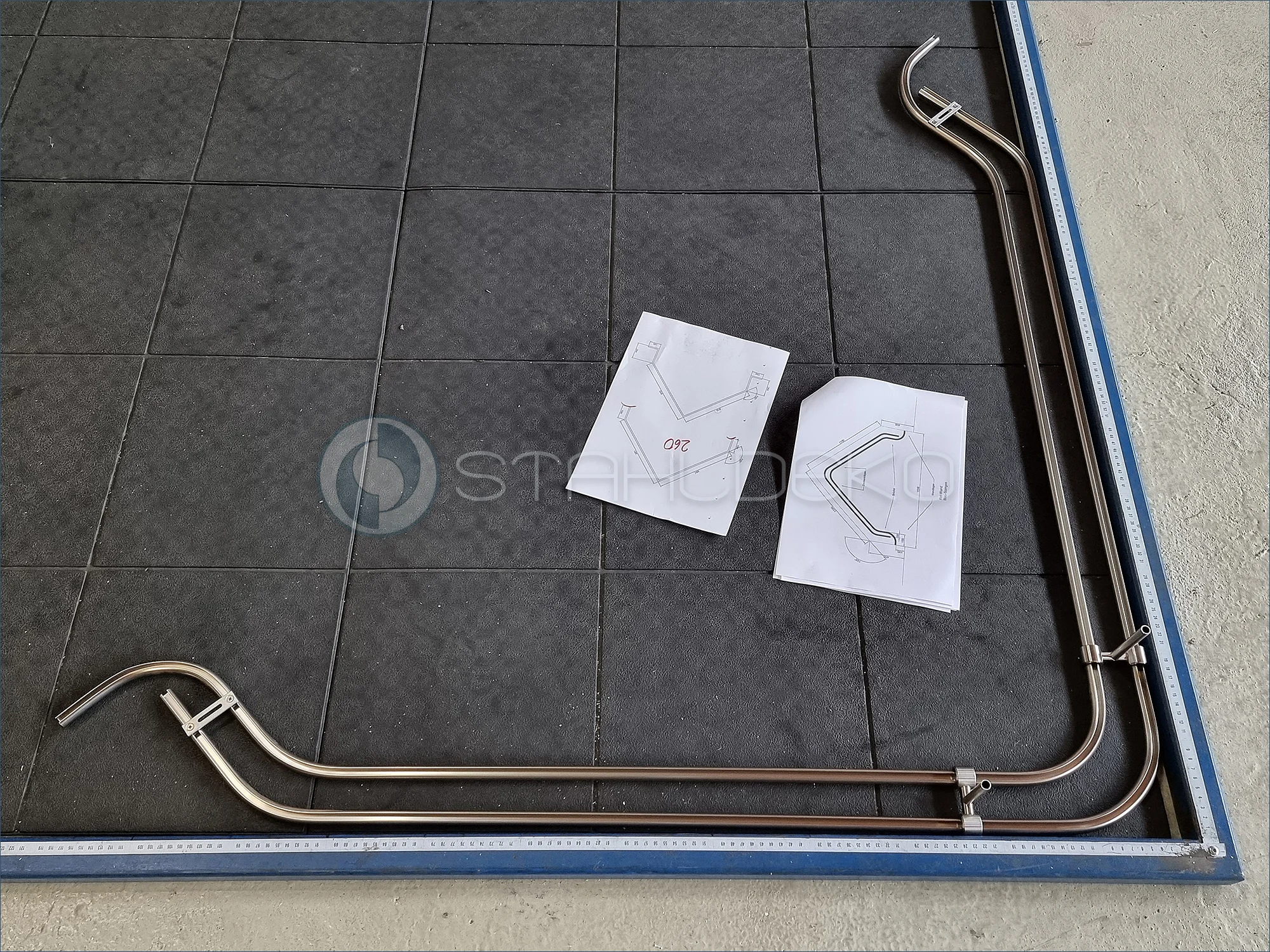
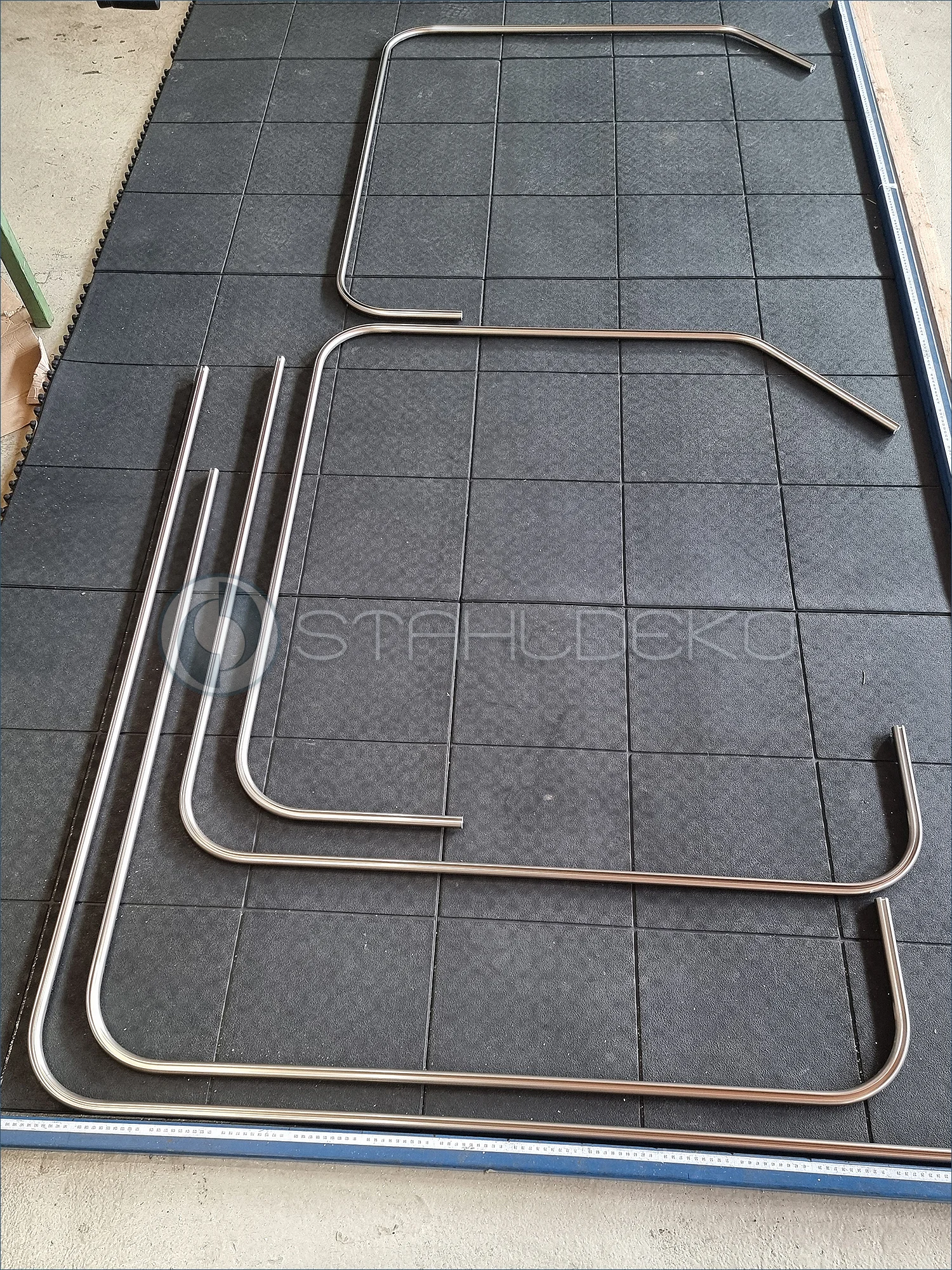
The workshop photos illustrate a practical inspection method. Curved internal-track profiles are laid out on a flat inspection surface, compared, and checked against the intended shape. With double-track assemblies, the outer contours are not the only concern. The spacing and parallel alignment of both tracks must also be correct for the finished curtain system to work as intended.
This becomes particularly clear with a custom curtain track for a seven-sided bay window. Several changes of direction combine into one continuous geometry tailored to the room. Producing such a structure requires much more than cutting a profile to length.
03 / Templates and patterns
Templates Make Unusual Room Shapes Tangible
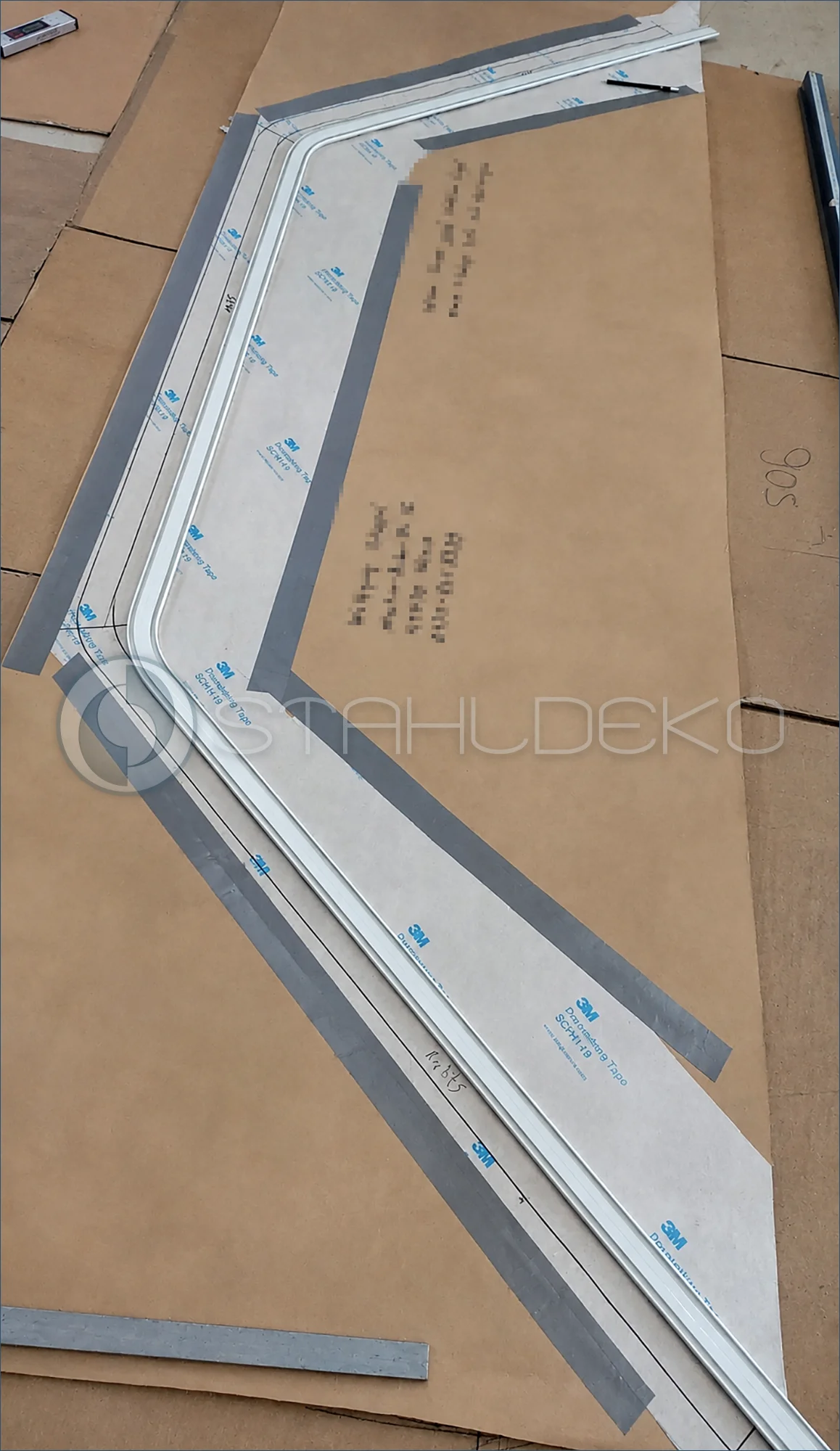
Not every shape can be adequately described with a few lengths and angles. Sometimes a physical template helps transfer the actual outline to the workshop. One photo shows a curved curtain track resting on a shaped pattern, allowing the profile to be checked against the planned contour.
This is especially helpful for asymmetrical bay windows, curved walls, and unusual transitions. The challenge is to turn the desired outline into a functional component without losing sight of how it will be used. With internal-track curtain systems, appearance is only part of the equation: The curtain must move along the intended path.
These photos document individual jobs rather than anonymous mass production. A template, a curved profile, and an inspection on the workshop floor already tell much of the manufacturing story.
04 / Metal fabrication
Bending Metal While Preserving Its Function
Bending a metal rod into a curve is only one part of the job. The bend must match the planned geometry, the finish must be protected, and the completed part must function properly. For curtain tracks with an internal glider channel, smooth movement is particularly important: The curve should not unnecessarily obstruct the curtain.
Depending on the product, Stahldeko works with different profiles and tubing. The gallery includes curved aluminum internal-track profiles as well as stainless steel tubes for curtain rods and shower curtain rods. The technical design depends on the product and its intended use.
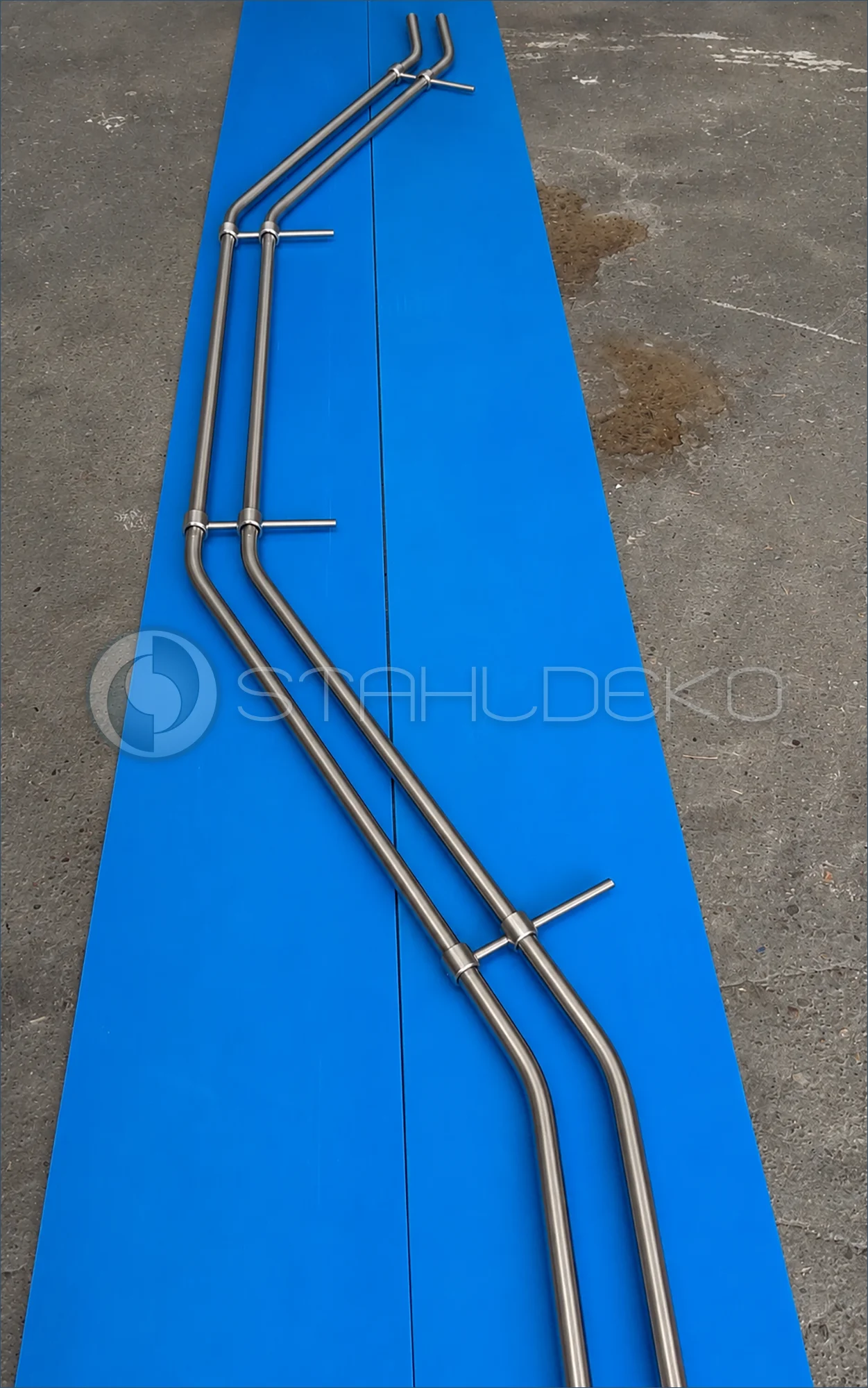
A workshop photo of curved stainless steel tubes on a blue surface makes the shaping process especially clear. The parallel curves have already been formed; their alignment and spacing can then be checked for the intended double-rod assembly.
05 / Trial assembly
Sometimes a Custom-Made Product Needs a Trial Assembly
The workshop photos also show components that have already been assembled for testing. For example, a curved bay-window curtain rod is temporarily fitted with universal ceiling suspension brackets. This allows the workshop to check how the curved rod and its mounting hardware work together.
A trial assembly distinguishes the manufacture of individual parts from the development of a complete installation solution. A structure may look correct on paper yet still raise questions: Where should the mounting points be? How will the track sit relative to the ceiling? Do all the components fit together?
Checking the assembly on the workshop floor makes it possible to address these questions before shipping. Custom manufacturing does not have to mean discovering only at the customer’s location whether the parts fit.
06 / Custom solutions
From Window Fronts to Trade Show Booths
The range of workpieces illustrates how different the requirements can be. Profiles are bent to follow the outline of a fireplace projection. A large continuous curtain track is made for a fitting room. At a trade show café, an oval structure can serve as a room divider. Other projects involve draft barriers, recreational vehicles, and unusually shaped shower areas.
These projects differ in dimensions and purpose. What they share is a design adapted to a specific location. The workshop must repeatedly solve new geometric problems. That makes production varied, but it also requires careful preparation and inspection.
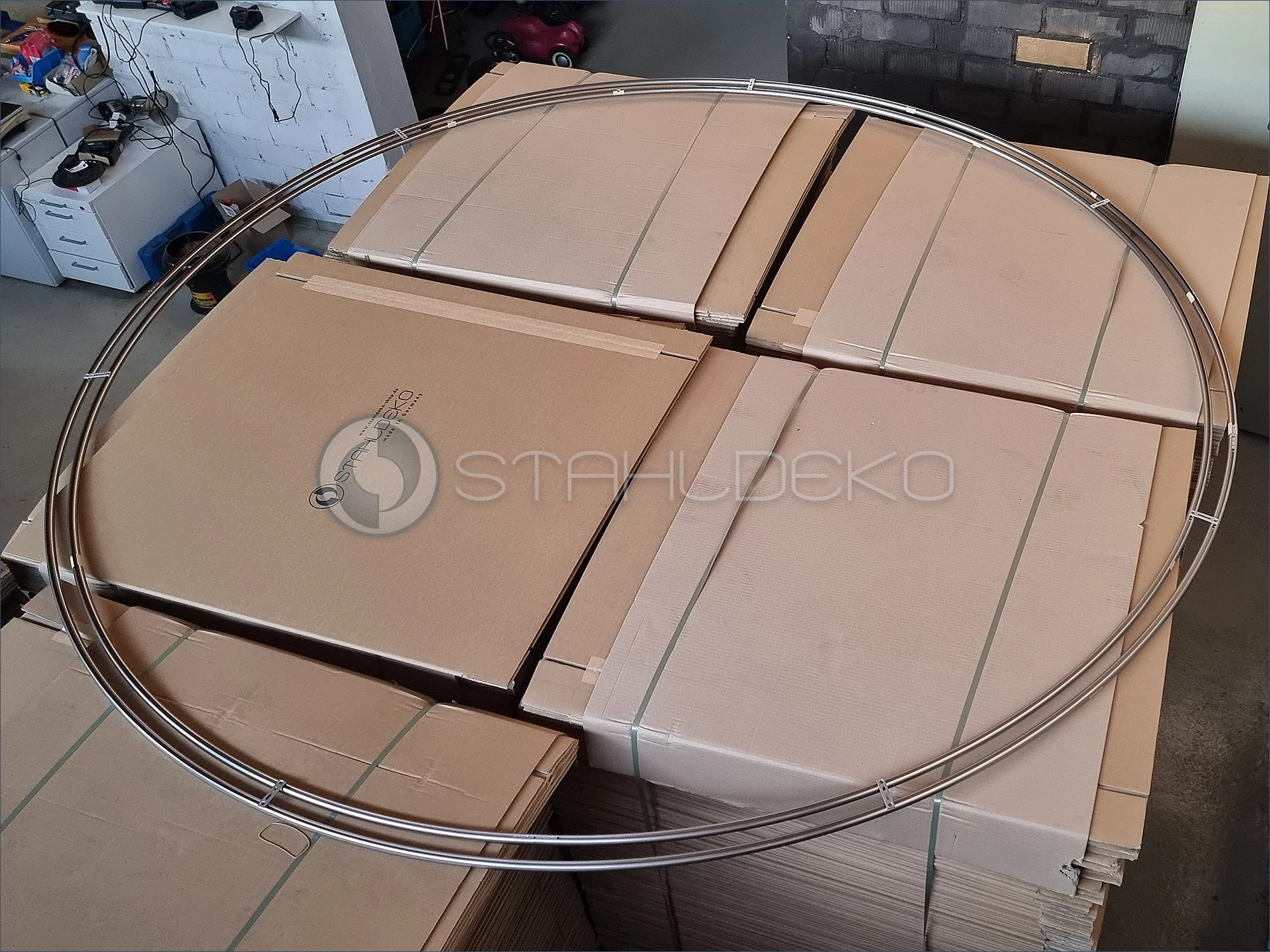
One example from the gallery is an oval double-track curtain system for a trade show space. Its shape is not merely decorative; it is intended to define a particular spatial layout. Checking the oval contour is therefore directly connected to its function.
07 / Larger orders
Shape Matters Even When Several Similar Parts Are Made
Not every order consists of a single piece. The workshop photos also show multiple shower curtain rods and curved internal-track profiles prepared for larger orders. Certain steps may be repeated, but each component still has to match the specified shape.
With curved shower curtain rods, details that are barely noticeable in product photos can matter: the alignment of the straight legs, the curvature, and the transition between straight and curved sections. Geometric inspection remains useful even when several units are produced for one order.
The pictures thus reveal two sides of the same business: highly individual one-off projects and orders involving multiple coordinated components.
08 / Quality inspection
Final Inspection Is Part of the Manufacturing Process
Once the bending is complete and the components are prepared, the work is not necessarily finished. The workshop photos repeatedly illustrate the same principle: Profiles are laid out, checked against drawings or templates, and assembled for testing when needed. The planned shape is compared with the actual finished piece.
This is particularly important at Stahldeko because many products are made not for a generic standard opening but for a particular room. What should later appear effortless—a curtain rod following a bay window or a curtain moving around a curve—requires a series of precise decisions beforehand.
And once the structure is complete, another challenge begins. Large curves, long profiles, and one-piece custom shapes must be packaged to help preserve their geometry during transport. Part 4 of this series explores just how demanding shipping and distribution can be.